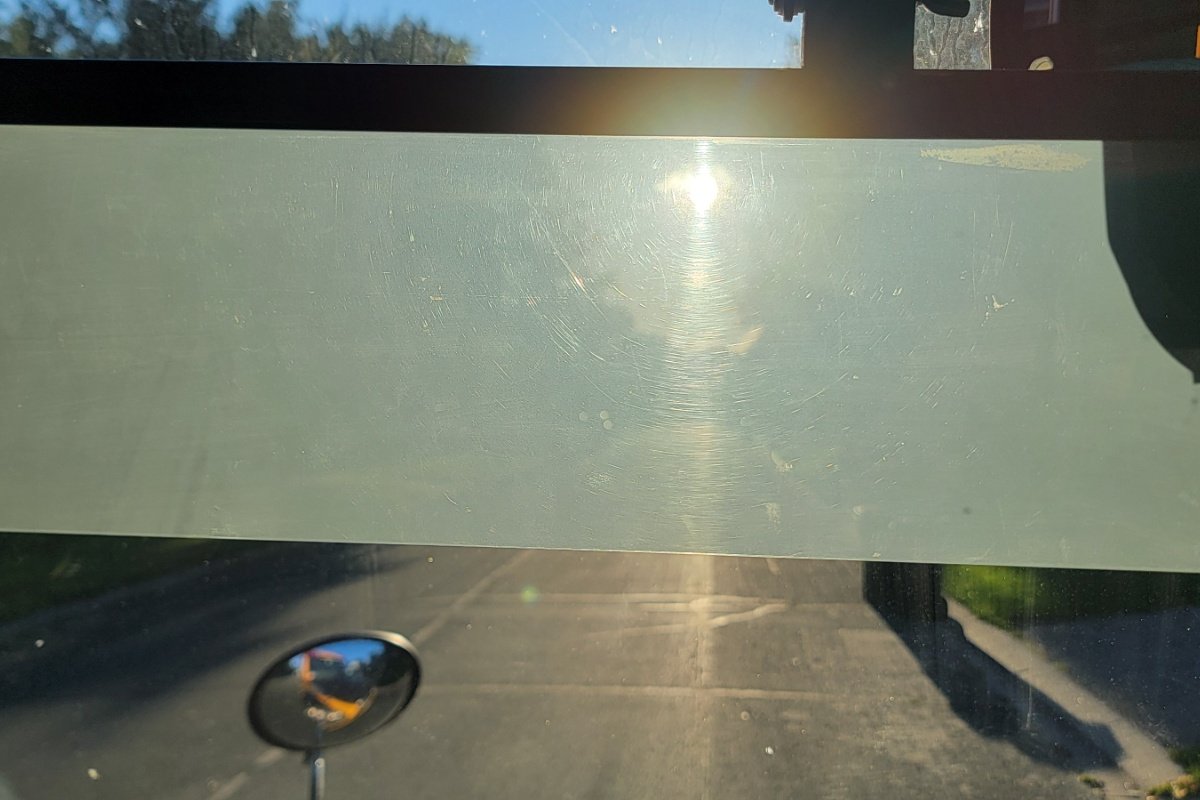
Every day, school buses carry millions of children across the United States, placing the responsibility for their safety in the hands of professional drivers. These vehicles are required to undergo annual safety inspections under Department of Transportation (DOT) regulations to ensure all systems meet federal safety standards. However, one critical component directly affecting driver visibility — the sun visor — is not included in these inspections.
Despite its essential function, the sun visor is not part of required DOT inspection criteria for commercial driver’s license (CDL) vehicles, including school buses. This regulatory gap has real-world consequences.
One school bus driver recently reported operating a bus with a severely faded, translucent green visor that offers no real protection against direct sunlight. During early morning routes, the low sun shines directly into the driver's eyes, causing dangerous glare, visual impairment, and extreme eye strain — all while transporting children.
Although the bus passed its DOT inspection, this only occurred because sun visors are not an inspection item. The issue was acknowledged by the driver’s employer, who has since ordered a replacement visor — a responsible response. However, the situation highlights a larger systemic problem: the DOT's current inspection standards fail to consider this basic yet crucial piece of safety equipment.
While some may suggest that drivers simply wear sunglasses, this is not a one-size-fits-all solution. Many CDL drivers have specific medical and corrective vision requirements that make wearing sunglasses either impractical or noncompliant. Furthermore, sunglasses do not replace the need for an adjustable visor capable of blocking direct sunlight from multiple angles.
Sun glare is a leading cause of visibility-related accidents, especially during sunrise and sunset. When it affects a school bus driver’s ability to see the road, signs, signals, and pedestrians — even momentarily — the risk to public safety is unacceptable.
A functioning sun visor is not an optional comfort feature; it is a key element of safe driving. Its absence or ineffectiveness compromises a driver's ability to operate a commercial vehicle safely.
The Federal Motor Carrier Safety Administration (FMCSA) and DOT must re-evaluate and modernize inspection criteria to reflect real-world driving conditions. Sun visors — particularly in school buses — should be considered mandatory safety equipment and included in annual inspection checklists.
This is not a local or isolated concern. It is a national safety issue that demands attention. Ensuring sun visors are functional and effective is a simple, low-cost change that could prevent accidents and protect lives — especially the lives of children who rely on safe transportation every day.